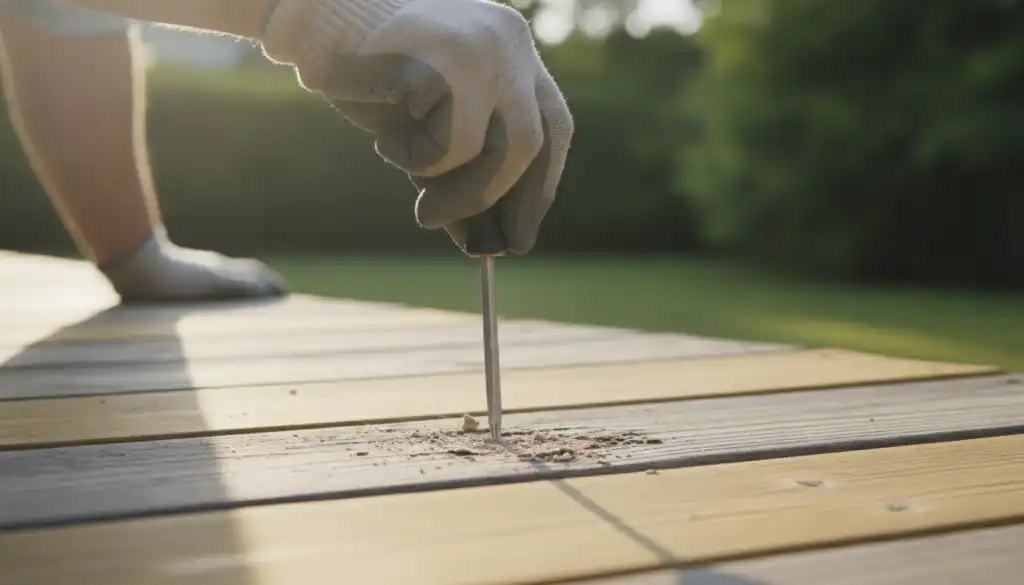
You step onto the back deck and a board gives a little under your foot. Maybe there’s a dull, earthy smell near the stairs, or a patch of wood near the house that looks darker and crumbly at the edges. If any board feels spongy, bouncy, or crushes when you press a screwdriver into it, stay off that section of the deck right now and keep kids and pets away until it’s checked. That soft spot is usually dry rot repair on a deck territory — and the sooner it’s addressed, the smaller and cheaper the fix.
Dry rot is a bit of a misnomer. It’s actually a fungal decay process that needs moisture to get started, even though the wood looks dry and crumbly once the fungus has done its damage. We see it constantly on decks around Ocala, Belleview, and especially out in Dunnellon, where humidity, afternoon storms, and ground moisture give decay fungus everything it needs. The good news: most dry rot is fixable without replacing the whole deck, if you catch it before it spreads into the framing.
Is this urgent?
Most dry rot starts small and stays a repair job, not an emergency. But a few signs mean you should stop using the deck and call a licensed contractor today, not next weekend:
- A board flexes, sags, or crushes under normal walking weight
- The ledger board (where the deck attaches to the house) feels soft or is pulling away from the siding
- Posts or support beams look spongy, split, or lean slightly
- You see daylight or gaps where fasteners used to hold tight
- Stairs wobble or railings move more than they used to
Any of those point to a structural issue, not just a cosmetic one. A deck that’s merely discolored or has a few soft spots at the surface is a repair project. A deck with a compromised ledger board or support post is a safety issue.
Symptom, Cause, and Quick Action
| What You’re Noticing | Most Likely Cause | What To Do |
|---|---|---|
| Soft, spongy boards near the house | Trapped moisture behind flashing | Stop walking on it; schedule an inspection |
| Crumbly, dark wood that flakes apart | Advanced fungal decay (dry rot) | Isolate the area; plan for board or joist replacement |
| Rot concentrated near the ground or posts | Poor drainage or soil contact | Check grading and ventilation under the deck |
| Small holes, sawdust-like material, or hollow-sounding wood | Possible termite or insect activity | Call a licensed contractor to rule out termites |
| Gray, weathered wood but still firm | Normal UV and weather aging | Clean, reseal, or stain as routine maintenance |
Cause 1: Trapped Moisture at the Ledger Board
What it looks like
The area where your deck bolts into the house is the single most common spot for dry rot repair on a deck to become necessary. Water gets behind flashing, soaks the ledger board, and the wood stays wet long after a Florida afternoon storm has passed.
What you can do
Look along the house-side band board for staining, soft texture, or a gap opening up between the deck and the siding. A quick poke with a flathead screwdriver tells you a lot — firm wood resists, rotted wood gives easily.
When to call a pro
If the ledger board is soft, call a licensed contractor immediately. This board carries a huge share of the deck’s load, and the International Code Council sets specific fastening and flashing standards for ledger connections precisely because failures here are dangerous.
Cause 2: Standing Water and Poor Drainage
What it looks like
Decks built low to the ground, or in a shaded, damp corner of the yard, often rot from the underside first. You’ll see darker wood on the bottom of joists or posts before it ever shows on top.
What you can do
Check that water drains away from support posts and that there’s airflow underneath the deck. Clear leaves, mulch, or debris that holds moisture against the wood.
When to call a pro
If rot has reached a support post or multiple joists, this becomes structural repair, not surface maintenance. According to the EPA’s guidance on moisture control, persistent dampness is the single biggest driver of wood decay in residential structures — which matches exactly what we see on service calls across Marion County.
⚠️ Common Mistake: Painting or staining over a soft board to "seal it in." Coating decayed wood traps moisture and hides the problem instead of fixing it — the rot keeps spreading underneath.
Cause 3: Termite or Insect Damage Mistaken for Dry Rot
What it looks like
Termite damage can look a lot like fungal decay at first glance — hollow wood, crumbling edges, discoloration. The giveaway is often tiny pinholes, mud tubes along a post, or a hollow sound when you tap the wood.
What you can do
Tap several spots with a hammer handle. A dull, hollow thud across a wider area, rather than one isolated soft board, suggests insects rather than isolated moisture rot.
When to call a pro
Any suspicion of termites warrants a professional inspection before any repair work starts, since treating the wood and treating an active colony require different approaches entirely.
Cause 4: Age, UV Exposure, and Lack of Maintenance
What it looks like
Untreated or unsealed wood breaks down naturally over years of Florida sun and rain. The grain roughens, color grays, and small cracks appear — but the wood underneath still feels solid.
What you can do
This is maintenance, not rot. A good cleaning, sanding of rough spots, and a quality sealer or stain can add years of life. We cover this in more detail in our guide to spotting early signs your deck boards are rotting.
When to call a pro
If aging wood is also soft or crumbly in spots, that’s no longer just weather wear — it’s decay layered on top of age, and worth a proper look.
DIY Check vs. Professional Repair
A homeowner can absolutely do the first-pass check safely. Walk the deck slowly, press firmly on boards near the house and at the stair base, and probe any discolored wood with a screwdriver. If everything resists and feels solid, you’re likely dealing with cosmetic weathering.
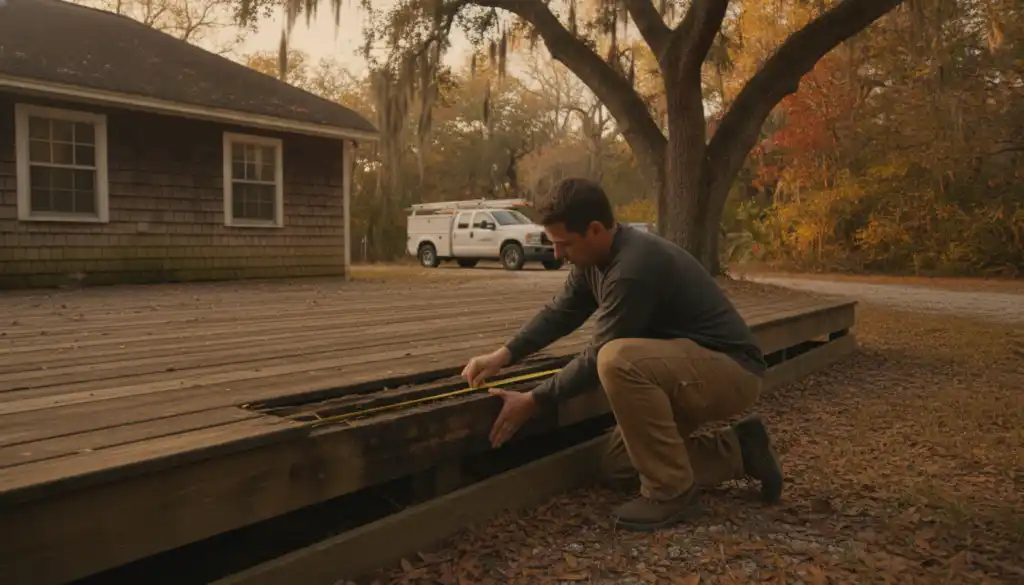
What a DIY check can’t tell you is how far decay has traveled into the framing, whether the ledger board attachment still meets current code, or whether a permit is required for the repair. As a licensed residential contractor (CRC1333200) with 35+ years in the trade and over 120 years of combined team experience, we’ve replaced enough deck boards over the years to know that the visible soft spot is often just the edge of a bigger area underneath. A professional repair typically includes removing decayed material back to solid wood, correcting the drainage or flashing issue that caused it, and confirming the fix meets Marion County building code requirements before anything gets closed back up.
The USDA Forest Products Laboratory has published decades of research confirming that decay fungi need sustained moisture above roughly 20% wood moisture content to establish — which is why fixing the moisture source matters as much as replacing the board itself. Skip that step, and new wood rots again in a season or two.
Quick Checklist Before You Call
- Note which boards, posts, or the ledger board feel soft
- Check for standing water, poor drainage, or debris trapped underneath
- Look for pinholes or hollow sounds that might point to termites instead
- Keep foot traffic off any section that flexes or crushes
- Call a licensed contractor for a full inspection before patching anything yourself
At Always Home Repair, we’ve handled wood rot repair across Central Florida for homeowners in Dunnellon, Ocala, Belleview, and the surrounding communities for decades, and our deck repair and rebuild services cover everything from a single board swap to full structural correction. We’re licensed under CRC1333200, family-owned, and we don’t consider a job done until you are satisfied with it. If you’re weighing options, our wood rot repair cost overview walks through what typically drives pricing up or down.
If you’ve found soft wood on your deck, don’t wait for it to get worse. Call Always Home Repair for a free estimate, and let one licensed team give you an honest answer — done right the first time.